


GMP pharmaceutical clean room is the key to environmental control of the production environment of pharmaceutical industry. Energy saving is a priority for our system solutions. What we are best at is to provide environmental solutions that comply with GMP, Fed 209D, ISO14644 and EN1822 international standards, and apply energy-saving technology. We can provide GMP turnkey solution from initial planning to final operation like personnel flow and material flow solutions, clean room structure system, clean room HVAC system, clean room electrical system, clean room monitoring system, process pipeline system, and other overall installation supporting services, etc.
Process layout of GMP pharmaceutical clean room
①The layout is reasonable and compact. Only necessary process equipment and clean area with air cleanliness level requirements are arranged in clean room.
②On the premise of meeting the production process requirements, clean rooms or clean areas with high air cleanliness should be close to AHU machine room. Processes and clean rooms with the same air cleanliness level should be arranged in a centralized manner. AHUs should be arranged near the entrance of the clean rooms with lower cleanliness levels.
③Processes in clean room that require high air cleanliness should be arranged on the upwind side, and process equipment that is prone to pollution should be arranged close to the return air outlet.
④Clean room should consider the transportation routes for the installation and maintenance of large equipment, and reserve equipment installation and maintenance openings.
Personnel flow and material flow in GMP pharmaceutical clean room
Direction of personnel flow: change room → air shower → clean corridor → clean workshop.
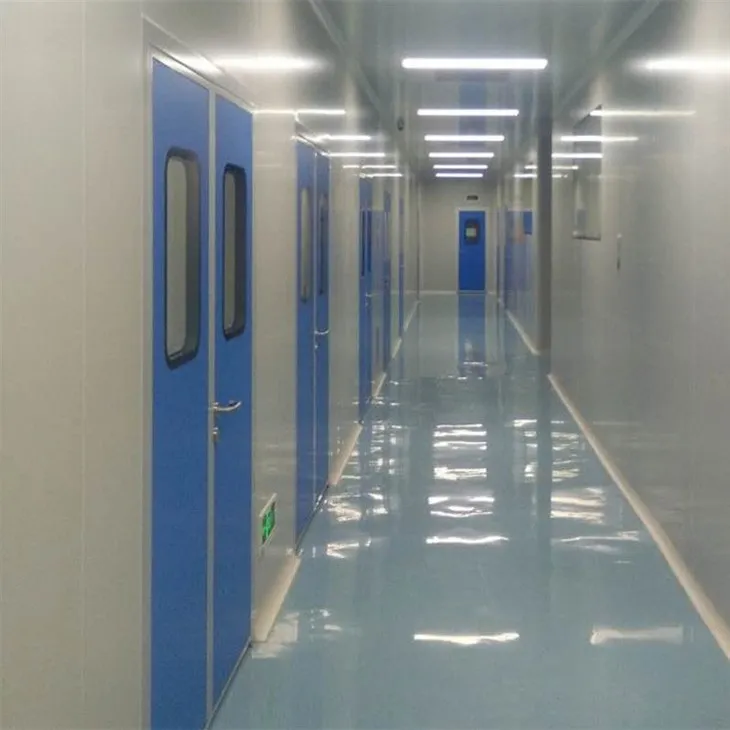
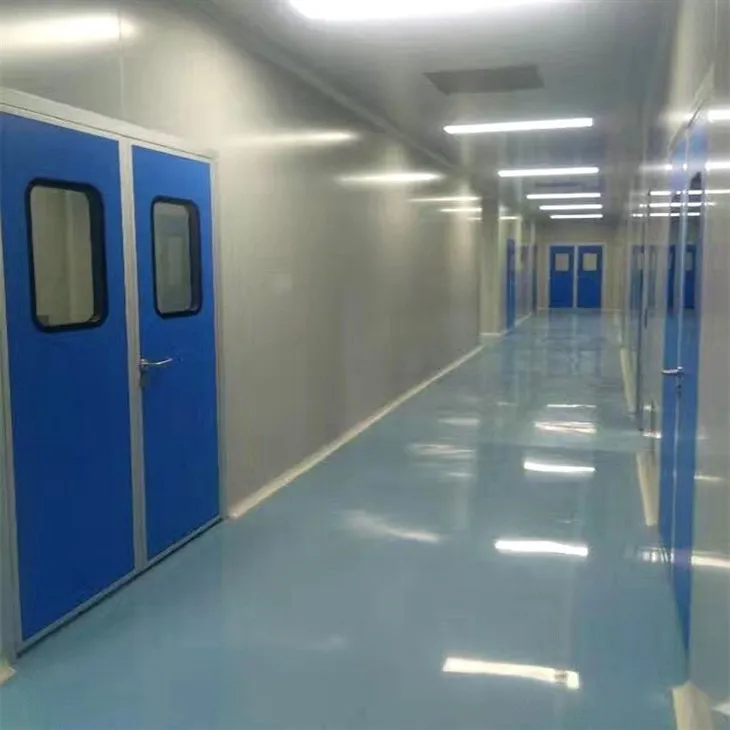
Install cleanroom emergency doors in clean room and corridors to facilitate personnel evacuation.
Material flow direction: logistics channel → clean workshop → finished product packaging.
Construction materials of GMP pharmaceutical clean room
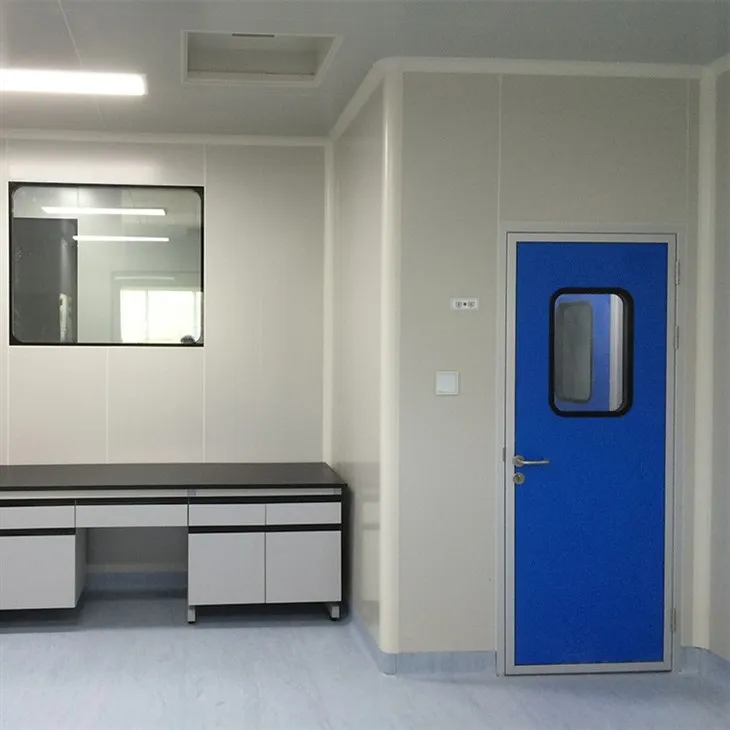
The walls and ceiling of the clean workshop must be constructed with materials that do not produce dust and have smooth surfaces that do not accumulate dust, and there must be no dead corners in clean workshop. Use specialized clean room sandwich panels, doors, windows and aluminum profiles in order to improve the service life of the clean room and achieve a beautiful and elegant effect.
The floor of the clean workshop is made of epoxy resin, with a dense surface and no sand, hollows or cracks. It has bright colors, long-lasting anti-static properties, can withstand loads below medium, and is resistant to high temperatures. On the basis of meeting the needs of use, it can play a decorative role, is wear-resistant, washable, dust-proof, anti-slip, has excellent performance, and has uniform color and gloss.
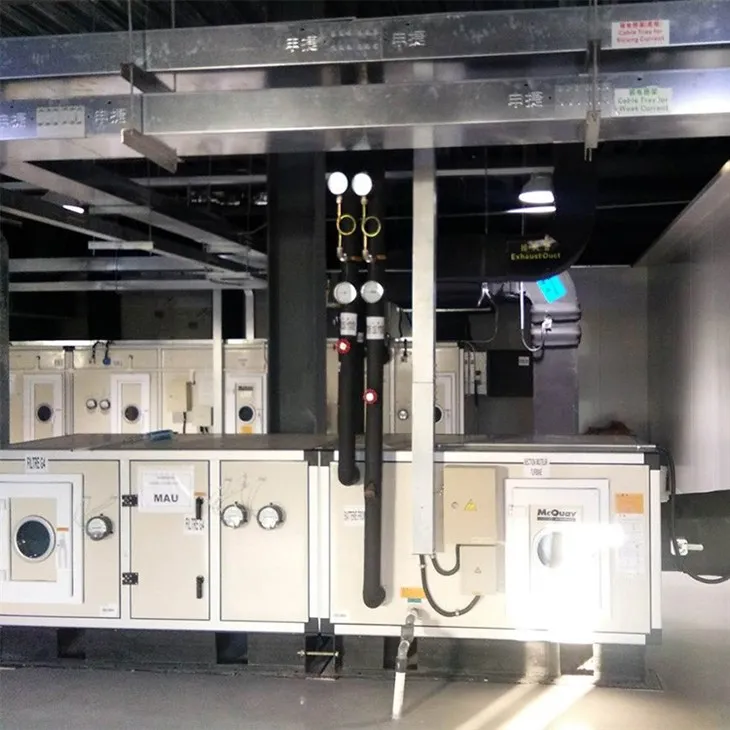
Cleanroom HVAC system must be designed with air supply and return system in accordance with the requirements of the regulations. Each supply and return air duct is connected to AHU in the technical mezzanine to form purification air conditioning system. The supply and return air ducts are made of high-quality galvanized steel plates and are connected through air dampers. Galvanized air ducts are made on site.
Testing content of GMP pharmaceutical clean room
Testing items: air velocity, air volume and air change, temperature and humidity, pressure difference, suspended particles, sedimentation bacteria, noise, illumination, etc.
①Air velocity, air volume and air change
The cleanliness of clean rooms and clean areas is mainly achieved by sending in a sufficient amount of clean air to displace and dilute the particulate pollutants produced in clean room. For this reason, it is very necessary to measure the air supply volume, average air velocity, air supply uniformity, air flow direction and flow pattern of clean rooms.
Unidirectional flow mainly relies on clean airflow to push and displace the polluted air to maintain the cleanliness of the clean rooms. Therefore, the air velocity and uniformity of its air supply section are important parameters that affect cleanliness. Higher, more uniform cross-sectional air velocity can remove pollutants generated by indoor processes more quickly and effectively, so they are the main testing items to focus on.
Non-unidirectional flow mainly relies on the incoming clean air to dilute and dilute the pollutants in clean room to maintain its cleanliness. Therefore, the bigger the air changes, the more reasonable the air flow pattern, the more significant the dilution effect, and the cleanliness will be improved accordingly. Therefore, non-unidirectional flow clean rooms, clean air supply volume and corresponding air changes are the main air flow test items to focus on. To obtain repeatable readings, record the time average of the air velocity at each measuring point. The air change is equal to the total air volume of the clean room divided by the volume of the clean room.
②Temperature and humidity
Clean room temperature and humidity measurement are usually divided into two levels: general testing and comprehensive testing. The first level is suitable for completion acceptance testing in an empty state, and the second level is suitable for static or dynamic comprehensive performance testing. This type of test is suitable for occasions with strict requirements on temperature and humidity performance. This test is performed after airflow uniformity test and after air conditioning system has been adjusted. When this test was conducted, the air conditioning system was fully operational and all conditions were stable. Set up at least one humidity sensor in each humidity control zone, and give the sensor sufficient stabilization time. The measurement should be suitable for the purpose of actual use. The measurement should be started after the sensor is stable. The measurement time should be no less than 5 minutes.
③Pressure difference
The purpose of this test is to verify the ability to maintain a specified pressure differential between the completed facility and the surrounding environment, and between spaces within the facility. This test applies to all 3 occupancy states. This test needs to be done regularly. The pressure difference test should be performed with all doors closed, from high pressure to low pressure, starting from the inner room farthest from the outside in terms of plan layout, and testing outward in sequence; adjacent clean rooms of different levels with interconnected holes, There should be reasonable airflow direction at the entrance of the hole, etc.
④Suspended particles
The minimum number of sampling points corresponds to the number of suspended particle sampling points. The measuring point position in working area is about 0.8-1.2m above ground. The measuring point position at air supply outlet is about 30cm away from air supply surface. Measuring points can be added at key equipment or key work activity ranges. Each sampling points are generally sampled once. After all sampling is completed, place the petri dishes in a constant-temperature incubator for no less than 48 hours. Each batch of culture media should have a control experiment to check whether the culture medium is contaminated.
⑤Sedimentation bacteria
The measuring point in working area is about 0.8-1.2m above ground. Place the prepared petri dish at sampling point, open petri dish cover, expose it for the specified time, then cover the petri dish, and place the petri dish at a constant temperature. Culture in an incubator for no less than 48 hours. Each batch of culture media should have a control experiment to check whether the culture medium is contaminated.
⑥Noise
The measurement height is about 1.2 meters from the ground. If the area of the clean room is less than 15 square meters, only one point in the center of the clean room can be measured; if the area is more than 15 square meters, four more diagonal points should be measured, one meter away from the side wall.
⑦Illumination
The measuring point plane is about 0.8 meters away from the ground, and the points are arranged at a distance of 2 meters. The measuring points in rooms within 30 square meters are 0.5 meters away from the side walls, and the measuring points in rooms over 30 square meters are 1 meter away from the wall.
Hot Tags: iso 14644 gmp pharmaceutical clean room solutions, China iso 14644 gmp pharmaceutical clean room solutions manufacturers, suppliers, factory, clean room double door, 2x8 led panel light, clean room hinged doors, 2x2 led panel light in the home, clean room automatic doors, high speed roll up door for clean room
|
Class |
Maximum Particles/m3 |
FED STD 209E Equivalent |
|||||
|
≥0.1 µm |
≥0.2 µm |
≥0.3 µm |
≥0.5 µm |
≥1 µm |
≥5 µm |
||
|
ISO 1 |
10 |
2 |
|||||
|
ISO 2 |
100 |
24 |
10 |
4 |
|||
|
ISO 3 |
1,000 |
237 |
102 |
35 |
8 |
Class 1 |
|
|
ISO 4 |
10,000 |
2,370 |
1,020 |
352 |
83 |
Class 10 |
|
|
ISO 5 |
100,000 |
23,700 |
10,200 |
3,520 |
832 |
29 |
Class 100 |
|
ISO 6 |
1,000,000 |
237,000 |
102,000 |
35,200 |
8,320 |
293 |
Class 1,000 |
|
ISO 7 |
352,000 |
83,200 |
2,930 |
Class 10,000 |
|||
|
ISO 8 |
3,520,000 |
832,000 |
29,300 |
Class 100,000 |
|||
|
ISO 9 |
35,200,000 |
8,320,000 |
293,000 |
Room Air |
|||


